
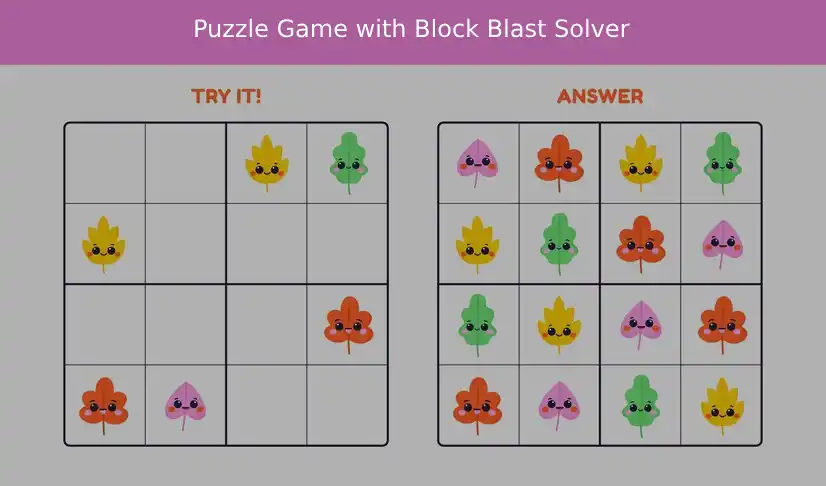
Block Blast has taken the mobile puzzle gaming world by storm. It combines the classic, addictive mechanics of Tetris with the strategic spatial planning of traditional 8×8 grid block puzzles. On the surface, placing colored blocks onto a grid seems effortlessly simple. However, as your score climbs into the thousands, space vanishes, awkward pieces start appearing, and a single mistake can quickly end a high-score run.
What is a Block Blast Solver and How Does It Work?
A Block Blast Solver is an algorithmic tool or tactical framework designed to calculate the most optimal block placements on an 8×8 grid. Similar to chess engines, these solvers evaluate the current state of your board, analyze the upcoming three blocks, and predict which sequence will yield maximum points while leaving open spaces for future moves.
The Core Mechanics Behind Solvers
Unlike action games that rely on fast reflexes, Block Blast operates strictly on mathematical probability and spatial organization. Modern web-based solvers or solver strategies utilize key principles:
- Board State Evaluation: Assessing the ratio of filled cells vs. empty cells to calculate immediate risk.
- Combo Path Optimization: Finding placements that trigger simultaneous row and column clears.
- Permutation Analysis: Checking all possible placement sequences for the three available blocks in your tray.
- Future-Proofing: Reserving key matrix shapes (like 3×3 open spaces) to accommodate large or awkward incoming pieces.
Step-by-Step Guide: How to Use Block Blast Solvers Effectively
While relying on an external solver for every single move can slow down your casual gameplay, using them as training tools will dramatically improve your natural puzzle intuition.
- Input Your Current Grid State: Most visual solvers allow you to upload a screenshot or tap to recreate your board’s filled tiles.
- Input Your Three Tray Blocks: Enter the exact shapes available in your current turn. Order matters, but exploring alternate order sequences is where high scores are built.
- Analyze the Suggested Placements: Observe where the solver places pieces. Pay close attention to why it chooses to hold off on clearing a row immediately to build a multi-line combo instead.
- Replicate and Learn: Apply the placements in your game and internalize the pattern recognition for future solo matches.
Pro Strategies: How to Play Like a Solver (Without Cheating)
You don’t need an active AI solver running next to you to hit massive scores. By adopting the exact rules that algorithms use, you can train your brain to spot optimal moves instantly.
1. Prioritize Center Control
The edges and corners of an 8×8 grid are natural traps. When blocks get stacked along the borders, filling the center without suffocating the grid becomes difficult. Keep the center clear whenever possible so you have flexibility to expand horizontally or vertically.
2. Always Plan for the 3×3 and Long 5-Block Pieces
The run-killers in Block Blast are the massive 3×3 solid square blocks and the long 5-tile horizontal/vertical lines. If your board does not have an open 3×3 space at all times, you are playing on borrowed time. Always maintain at least one region big enough to absorb large blocks.
3. Master the Art of Combo Multipliers
Clearing one line at a time will yield a low score. The secret to breaking 10,000+ points lies in combos (clearing lines in consecutive turns) and multi-clears (clearing 2, 3, or more lines with a single block). Always look for placement setups where one piece triggers a chain reaction.
Common Block Blast Mistakes and How to Fix Them
| Mistake | Why It Hurts Your Score | The Solver Solution |
|---|---|---|
| Clearing lines too early | Resets your combo chain and reduces potential points per piece. | Build up multiple lines to 7/8 filled before triggering a major clear. |
| Ignoring the 3-block set order | Placing piece #1 in a spot that blocks piece #3 leads to game over. | Mentally visualize all 3 pieces on the board before placing the first one. |
| Leaving single-cell gaps | Single empty holes are extremely difficult to fill with standard block shapes. | Keep block edges flush; avoid leaving isolated empty tiles in corner spots. |
Why Block Blast Solvers Are Great for Game Analysis
Using a solver isn’t just about getting a high score on a leaderboard—it is an educational tool for pattern recognition. Game theorists and casual gamers alike use these algorithmic predictions to understand probability distribution. Since block spawn mechanics in puzzle games can feel random, studying solver pathways teaches you how to turn low-probability hands into high-scoring recoveries.
Frequently Asked Questions (FAQs)
Q1: Is there an automatic Block Blast Solver app available?
Yes, there are online web solvers and helper apps where you can enter your current grid layout and tray pieces to calculate the best possible moves.
Q2: What is the highest score possible in Block Blast?
Technically, Block Blast has no cap on scores. As long as you maintain open space, avoid single-cell traps, and sustain line clears, you can play indefinitely.
Q3: How do I get out of a tight situation with big blocks?
Focus on clearing vertical or horizontal lines that intersect near the dense area of your board. Clearing even one line can open up enough space to fit a larger piece.





Leave a Reply