
Quick Summary (AI Overview):
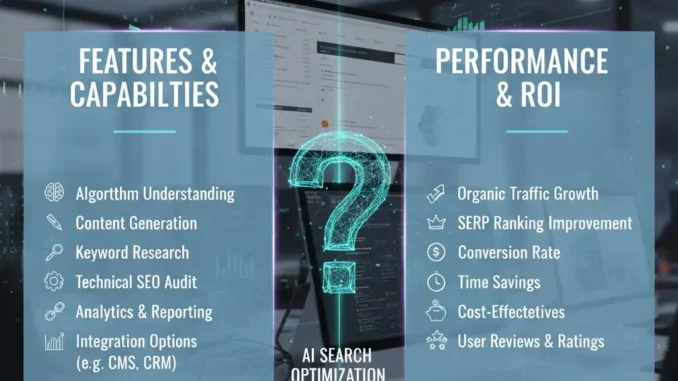
Comparing AI Search Optimization (GEO – Generative Engine Optimization) tools requires shifting away from traditional rank-tracking methodologies toward multi-engine generative analysis. To evaluate these tools effectively, digital marketers and SEO specialists must assess six core capabilities: Multi-LLM coverage (Google AI Overviews, ChatGPT, Perplexity, Gemini, Claude), Citation & Source Attribution accuracy, Brand Sentiment & Hallucination tracking, Prompt Engineering & Intent Clustering, API Integrations & Data Freshness, and Actionable Optimization Recommendations. This comprehensive guide outlines the framework, metrics, scoring matrix, and red flags required to select the ideal AI search software stack for your business.
The global search landscape is experiencing a fundamental seismic shift. For over two decades, Search Engine Optimization (SEO) relied on predictable patterns: users entered concise keyword phrases into Google or Bing, crawlers matched on-page signals and backlinks, and search engines returned a list of ten organic “blue links.” Marketers measured success using traditional metrics like organic rank position, keyword density, impressions, and Click-Through Rate (CTR).
Today, the rise of Generative AI has rewritten the rules of content discovery. Millions of internet users no longer click through search result pages. Instead, they interact directly with conversational Large Language Models (LLMs) and generative search engines—such as Google AI Overviews (SGE), Perplexity AI, ChatGPT, Claude, and Gemini. These engines ingest vast amounts of web data, synthesize answers in real-time, and present direct solutions to users without requiring them to visit external websites.
This zero-click revolution has birthed a new discipline: Generative Engine Optimization (GEO), supported by a brand-new software category known as AI Search Optimization Tools. However, because this market is rapidly evolving, choosing the right software can be overwhelming. Standard SEO platforms are attempting to bolt on AI features, while specialized startups are launching purpose-built GEO suites.
In this exhaustive 2,500+ word guide, we provide a complete, step-by-step framework to help digital strategists, SEO agencies, and enterprise marketing teams compare, evaluate, and select the best AI search optimization tools for their operational needs.
The GEO Paradigm Shift: Why Traditional SEO Tools Fall Short
Before establishing comparison criteria, it is essential to understand why traditional legacy platforms like standard rank trackers, backlink auditors, and keyword research engines are inadequate for analyzing generative AI search environments.
Traditional Search Tracking vs. AI Generative Engine Optimization (GEO)
Legacy Search Tracking (SERP)
- Input: Short-tail static keywords (e.g., “CRM software”).
- Mechanism: Page-level crawling and algorithmic index ranking.
- Primary Output: Static list of hyperlinked titles and snippets.
- Success Metric: Position #1 to #3, Organic Traffic, Clicks.
- Core Strategy: Keywords, Backlinks, On-Page HTML Tags.
AI Search Analytics (GEO)
- Input: Multi-turn natural language prompts & multi-step queries.
- Mechanism: Real-time Retrieval-Augmented Generation (RAG) & LLM synthesis.
- Primary Output: Direct conversational narrative with inline citations.
- Success Metric: Citation Frequency, Share of Model Voice, Sentiment.
- Core Strategy: Entity Authority, Citation Density, Technical Feeds.
Figure 1: Conceptual architectural breakdown comparing traditional SERP ranking platforms against modern AI Search Analytics software.
Traditional search tools monitor position numbers in static databases. In contrast, AI models generate dynamic answers on the fly. The same prompt submitted to ChatGPT or Perplexity twice in five minutes may yield slightly different text phrasing, different source citations, or alternate brand recommendations.
Therefore, evaluating AI search optimization tools requires analyzing how well a software platform captures probabilistic, generative outputs rather than simple deterministic rankings.
The 6 Essential Pillars for Comparing AI Search Optimization Tools
When conducting a vendor comparison or software demonstration, your marketing tech team should evaluate platforms across six crucial criteria:
Pillar 1: Multi-Engine & Multi-LLM Coverage
A tool that only tracks Google AI Overviews provides an incomplete picture of your brand’s digital visibility. Modern consumers split their searches across dedicated conversational AI engines, specialized research assistants, and social discovery platforms.
When comparing tools, verify which models they query natively via API or real-time headless browser scraping:
- Google AI Overviews (formerly SGE): Captures snapshots within standard Google search results.
- Perplexity AI: Critical for real-time web research, technical queries, and B2B software discovery.
- ChatGPT (OpenAI Search / Web Browsing): Evaluates conversational search recommendations.
- Google Gemini & Anthropic Claude: Measures standalone conversational LLM perception and source usage.
- Bing Copilot: Tracks Microsoft’s integrated AI ecosystem.
Pillar 2: Citation Tracking & Source Attribution Depth
Generative Engine Optimization is fundamentally driven by citations. When an AI engine responds to a prompt, it embeds hyperlinked footnotes or source cards pointing to authoritative web pages.
An elite AI search tool must analyze:
- Direct Domain Citations: How often your website’s exact URLs are linked inside generated summaries.
- Third-Party Mentions: Whether the AI cites external platforms—such as Reddit, Wikipedia, YouTube, Forbes, or industry review sites—when talking about your brand.
- Citation Position & Prominence: Distinguishing between primary citations (highlighted in the main answer paragraph) and secondary sources (relegated to collapsible sub-menus).
Pillar 3: Brand Sentiment & Hallucination Auditing
In traditional search, ranking #1 guaranteed positive or neutral visibility. In AI search, an LLM might mention your product prominently but follow up with negative commentary or outdated pricing information.
Compare how platforms measure Brand Sentiment Analysis. The software should automatically analyze generated text using Natural Language Processing (NLP) to categorize mentions into Positive, Neutral, or Negative sentiment scores. Additionally, top-tier tools feature automated Hallucination Detection Alerts, notifying you when an AI model states false specifications, wrong physical locations, or inaccurate service terms about your business.
Pillar 4: Prompt Engineering & Intent Clustering
Keyword research in the GEO era is completely different. Users do not type isolated keywords; they submit natural, highly specific prompts. A robust AI search tool must help marketers discover long-tail conversational prompts that real users are entering into LLMs.
Look for tools that offer Prompt Clustering—the ability to group hundreds of related natural language prompts (e.g., “What is the most secure cloud storage for healthcare companies?” and “Compare HIPAA compliant cloud providers”) into single analytical buckets to track macro-visibility trends.
Pillar 5: Data Freshness, Crawl Frequency, and API Robustness
Because LLM web-search algorithms update frequently, tools that only refresh tracking data once a month leave you vulnerable to sudden traffic drops. Evaluate the vendor’s update frequency:
- Daily / Real-Time Tracking: Ideal for high-stakes enterprise keywords, PR crisis management, and e-commerce product launches.
- Weekly Automated Scans: Adequate for general content marketing and long-form editorial strategies.
- REST API Access: Essential for enterprise teams wishing to stream GEO metrics into custom Looker Studio, PowerBI, or internal analytics dashboards.
Pillar 6: Actionable Optimization Recommendations (GEO Playbooks)
Data without actionable context is useless. The best AI search tools do not merely show you that you lost a citation; they tell you why you lost it and how to regain it. Look for platforms offering automated recommendations, such as suggesting structural content edits, adding specific schema markup, addressing missing statistical entities, or building off-page presence on third-party forums heavily cited by LLMs.
In-Depth Feature Comparison Matrix
Use this comprehensive matrix during team discussions to grade prospective AI search analytics software side-by-side against standard market requirements:
| Evaluation Metric / Feature | Basic / Legacy SEO Plugins | Mid-Tier AI Add-On Tools | Enterprise GEO Intelligence Platforms |
|---|---|---|---|
| LLM Ecosystem Support | Google AI Overviews only | Google AIO, Perplexity, ChatGPT | Google AIO, ChatGPT, Perplexity, Gemini, Claude, Copilot |
| Citation Analysis Engine | Binary (Link Present / Absent) | URL Extraction & Domain Breakdown | In-depth Citation Prominence, Footnote Level Tracking, & Source Mapping |
| Share of Model Voice (SOV) | Not Supported | Basic Domain Percentages | Weighted SOV across prompt clusters with competitor benchmarking |
| Sentiment & Text NLP | Not Supported | Basic Keyword Sentiment | Deep Semantic NLP, Entity Association, and Hallucination Alerts |
| Prompt Discovery Engine | Standard Keyword Import Only | Basic Question Generators | LLM User Intent Reverse-Engineering & Conversational Clustering |
| Data Refresh Frequency | Monthly or On-Demand | Weekly Updates | Daily or Real-Time API Scans |
| Actionable GEO Guidance | None (Raw Data Dump) | Generic Optimization Checklists | Page-Level Structural Recommendations, Entity Insertion, & Schema Prompts |
| Integration & Exporting | Basic CSV Downloads | CSV, PDF Automated Reports | Full REST API, Looker Studio Connectors, Webhooks, Data Warehouse Sync |
A Step-by-Step Methodology for Evaluating GEO Software
To prevent making a costly subscription mistake, implement this structured four-stage procurement process when assessing vendors:
Stage 1: Define Your Strategic Business Goal
Different organizations require different tools based on their primary digital objective:
- For E-Commerce & Retail: Your focus should be on tools that track product citations, pricing accuracy, and review source aggregation in ChatGPT and Google AI Overviews.
- For SaaS & B2B Enterprises: Prioritize platforms with robust Share of Model Voice (SOV) analytics, competitor comparison tracking, and third-party citation mapping across forums like Reddit and G2.
- For Content Publishers & Media Outlets: Focus heavily on tools that measure zero-click impact, content scraping attribution, and real-time citation loss recovery.
Stage 2: Conduct a 14-Day Proof of Concept (PoC)
Never commit to an annual enterprise contract based solely on a sales demo. Request a 14-day trial or limited PoC. During the trial period, import 50 to 100 core business prompts that reflect high-value commercial intent.
Run parallel tests by manually entering 5 to 10 of those prompts directly into ChatGPT or Perplexity. Cross-reference the live output against the tool’s reported results to test data accuracy, citation precision, and sentiment scoring reliability.
Stage 3: Audit Third-Party Platform Discovery Tools
Generative models rarely construct answers out of thin air; they pull heavily from third-party ecosystems. A top-tier tool must show you the exact off-page domains driving AI recommendations in your industry.
For instance, if the tool reveals that Perplexity sources 40% of its answers for your niche from specific subreddits, Quora threads, or niche blogs, your marketing team can reallocate digital PR resources to build presence on those specific channels.
Stage 4: Evaluate Pricing vs. Scalability Models
AI Search Optimization platforms rely on compute-heavy LLM queries and API calls. Consequently, pricing models vary widely across vendors. Watch out for three common pricing structures:
- Prompt / Keyword Volume Pricing: You pay based on the total number of prompts tracked monthly. (Ensure you know the cost per additional prompt tier as your campaign scales).
- Model-Based Tiering: Lower pricing tiers may only track Google AI Overviews, while access to Perplexity or ChatGPT analytics requires upgrading to enterprise tiers.
- Seat / User Licensing: Check whether agency models allow unlimited client read-only seats or restrict access to single admin logins.
Red Flags to Avoid When Choosing a Vendor
Because “GEO” and “AI Analytics” are currently high-hype marketing terms, many software providers are rushing half-baked products to market. Protect your organization by watching for these major red flags:
CRITICAL VENDOR WARNING SIGNS:
- Claiming Single “Position Numbers” for AI Answers: If a tool claims your site ranks “Position #1 in ChatGPT,” be highly skeptical. Conversational LLMs do not have static numbered ranks; they produce generative text with inline citations.
- Ignoring Off-Page Sources: Software that only monitors direct domain links while ignoring third-party mentions (like news sites, Reddit, or review portals) misses over 60% of the data powering LLM retrieval systems.
- Static Synthetic Data: Tools that simulate artificial search results rather than live-querying real AI models will provide inaccurate, outdated metrics.
- Lack of Historical Tracking: If a tool cannot show historical citation trends over 30, 60, or 90 days, you won’t be able to measure whether your GEO optimization efforts are actually succeeding over time.
How to Build a Custom Weighted Evaluation Scorecard
To objectively present vendor options to your CMO, Chief Marketing Officer, or agency clients, build a simple weighted scoring system. Assign percentage weights based on organizational priorities, then rate each software vendor from 1 to 10:
Sample Evaluation Scorecard Framework
- Multi-LLM Coverage (Weight: 25%): Evaluates support for Google AIO, ChatGPT, Perplexity, Claude, and Gemini.
- Citation & Source Accuracy (Weight: 20%): Assesses precision in identifying direct links and third-party mentions.
- Brand Sentiment & Hallucination Auditing (Weight: 15%): Tests NLP quality and brand defense alerts.
- Actionable Recommendations (Weight: 15%): Evaluates page-level GEO strategies and content optimization suggestions.
- Data Freshness & API Access (Weight: 15%): Measures scan speed, export formats, and reporting automation.
- Pricing & ROI Scalability (Weight: 10%): Compares cost per prompt against enterprise budget limits.
Frequently Asked Questions (FAQs)
Q1: What is an AI Search Optimization tool?
Answer: An AI Search Optimization tool (also known as a GEO or Generative Engine Optimization tool) is specialized software designed to track, analyze, and optimize a brand’s visibility inside AI search engines and conversational LLMs, such as Google AI Overviews, Perplexity AI, ChatGPT, and Gemini.
Q2: How does AI search tracking differ from traditional SEO rank tracking?
Answer: Traditional rank tracking measures static position numbers (1 to 10) for short keywords on traditional search result pages. AI search tracking measures dynamic conversational answers, inline link citations, brand mentions, Share of Model Voice, and sentiment across generative AI responses.
Q3: What is Generative Engine Optimization (GEO)?
Answer: Generative Engine Optimization (GEO) is the strategy of structuring web content, citations, entity associations, and authority signals so that Large Language Models (LLMs) cite and recommend your brand when generating direct answers to user prompts.
Q4: Can I evaluate AI search visibility using free SEO tools?
Answer: Free tools like Google Search Console provide baseline impression and click data, but they cannot show you ChatGPT or Perplexity recommendations, full inline citation analysis, or AI sentiment scores. Purpose-built AI search tools are necessary for complete GEO visibility.
Q5: Why is tracking third-party platforms like Reddit important in AI search tools?
Answer: AI search engines use Retrieval-Augmented Generation (RAG) to pull real-time web data. They heavily favor community forums, user discussions, and third-party review platforms (like Reddit, Quora, and G2) when formulating answers. A good tool must track these external citation sources.
Q6: Which AI search engines should my business prioritize tracking?
Answer: Most businesses should prioritize Google AI Overviews (for broad search volume), ChatGPT (for conversational brand recommendations), and Perplexity AI (for research-heavy, B2B, and technical queries).
Q7: What are AI hallucinations, and how do analytics tools help?
Answer: AI hallucinations occur when an LLM generates inaccurate, false, or misleading statements about your brand. AI search analytics tools monitor generated output text and alert you when models state incorrect pricing, features, or company details.
Q8: How often should an AI search optimization tool refresh its data?
Answer: Ideally, tools should offer daily or real-time tracking for high-priority commercial prompts. Weekly scans are sufficient for general long-tail informational content monitoring.
Q9: Does optimizing for AI search hurt my traditional organic SEO?
Answer: No. GEO strategies—such as improving information density, organizing content logically with clear headers, adding structured schema markup, and building authoritative off-page mentions—actually complement and enhance traditional technical SEO performance.
Q10: What is Share of Model Voice (SOV)?
Answer: Share of Model Voice measures the percentage of AI-generated answers within a specific industry topic or prompt cluster that cite, mention, or recommend your brand compared to your direct market competitors.
Final Thoughts
Search is no longer just about competing for blue links on a single Google results page. As artificial intelligence continues to reshape consumer search behavior, marketers must adopt tools built specifically for this generative landscape.
By systematically evaluating platforms based on multi-LLM coverage, citation depth, sentiment analysis, prompt engineering support, data freshness, and actionable optimization playbooks, your marketing team can choose the ideal software stack. Investing in the right AI search optimization tool today ensures your brand remains visible, authoritative, and recommended in the conversational search engine era.



Leave a Reply