
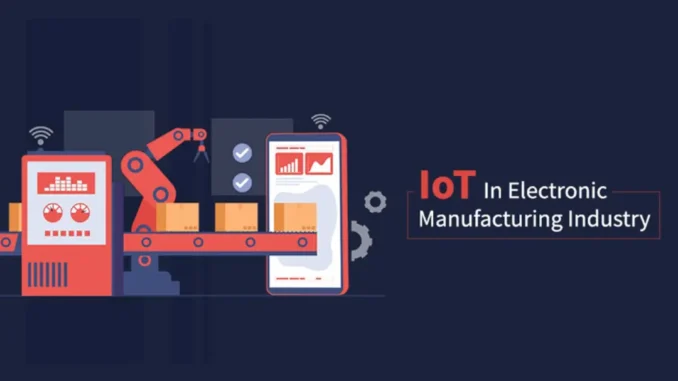
The electronics manufacturing industry is currently experiencing its most profound structural evolution since the advent of surface-mount technology (SMT) and automated assembly lines. Driven by the convergence of high-speed connectivity, artificial intelligence, edge computing, and sensor technology, the global industrial sector has shifted from traditional automated factories into hyper-connected, self-optimizing ecosystems commonly referred to as Industry 4.0.
At the absolute core of this transformation lies the Industrial Internet of Things (IIoT). Modern electronics manufacturing is uniquely complex: component form factors are shrinking to sub-millimeter scales, high-frequency printed circuit board (PCB) layouts demand micro-inch precision, consumer product life cycles are collapsing from years to months, and global supply chains remain vulnerable to geopolitical and material disruptions. Legacy operational paradigms relying on isolated machinery, manual batch sampling, and reactive maintenance can no longer sustain competitive yields or operational margins.
This comprehensive guide examines how IIoT architectures, predictive telemetry, smart factory automation, and digital twins are fundamentally reshaping modern electronics manufacturing. We will explore end-to-end applications across SMT assembly, wafer fabrication, predictive quality control, supply chain orchestration, cyber-physical security, and real-world deployment frameworks designed for maximum return on investment (ROI).
Executive Overview: Integrating Industrial IoT across electronics manufacturing facilities yields an average 20-30% reduction in unplanned downtime, a 15-25% improvement in Overall Equipment Effectiveness (OEE), and up to a 40% drop in scrap rates through real-time telemetry, closed-loop feedback, and AI-driven predictive control.
1. The Paradigm Shift: From Traditional Automation to IIoT-Driven Smart Factories
Automation in electronics manufacturing is not inherently new. Programmable Logic Controllers (PLCs), robotic pick-and-place systems, and automated optical inspection (AOI) machines have been deployed on factory floors for decades. However, traditional automation operates in data silos. An isolated SMT line machine performs its designated task efficiently, but its internal sensor metrics—vibration signatures, motor currents, local temperatures, and nozzle pressures—remain trapped within proprietary machine controllers.
The Industrial Internet of Things removes these data siloes by superimposing a continuous, bidirectional communication layer across every level of the manufacturing stack. By embedding micro-sensors and edge nodes across the shop floor and connecting them via industrial protocols (such as MQTT, OPC UA, and Modbus), IIoT unifies operational technology (OT) with enterprise information technology (IT).
| Operational Dimension | Legacy Electronics Manufacturing | IIoT-Enabled Smart Factory |
|---|---|---|
| Data Visibility | Isolated machine displays, manual logging, periodic batch reports. | Real-time centralized dashboards, edge analytics, cloud telemetry. |
| Maintenance Model | Reactive (fix when broken) or calendar-based preventive maintenance. | Predictive and prescriptive maintenance driven by machine learning. |
| Quality Control | Post-process inspection, end-of-line testing, destructive sampling. | In-line continuous monitoring, closed-loop feedback, zero-defect execution. |
| Line Flexibility | Rigid high-volume setup; lengthy reconfiguration times. | Agile high-mix low-volume (HMLV) production with dynamic recipe loading. |
2. Architectural Framework of Industrial IoT in Manufacturing
To understand how IoT operates on the factory floor, we must dissect its technical layer stack. An enterprise IoT architecture comprises four interconnected layers:
A. Perception & Sensing Layer (Physical Environment)
This layer includes physical sensors embedded into SMT equipment, reflow ovens, wave soldering units, cleanrooms, and robotic arms. Key sensors deployed in electronics assembly include:
- Piezoelectric Vibration Sensors: Attached to high-speed pick-and-place gantry motors to monitor bearing wear and mechanical instability.
- Thermal Infrared Arrays & Thermocouples: Deployed inside reflow soldering ovens to monitor thermal profiles across multi-zone chambers continuously.
- Optical & Laser Displacement Sensors: Measure solder paste deposition thickness with sub-micron accuracy.
- Environmental Cleanroom Sensors: Track relative humidity, temperature, electrostatic discharge (ESD) build-up, and airborne particulate concentration.
B. Transport & Connectivity Layer
Raw telemetry data generated by thousands of sensors must be reliably transmitted without interfering with real-time machine operations. Industrial communication frameworks utilize high-reliability deterministic protocols such as Industrial Ethernet (PROFINET, EtherCAT), OPC Unified Architecture (OPC UA), MQTT over TLS, Private 5G, and Wi-Fi 6 enterprise networks.
C. Edge Computing & Middleware Layer
In high-speed PCB assembly, waiting for data to travel to a cloud server and back introduces unacceptable latency. Edge gateways situated directly on the factory floor process high-frequency sensor feeds locally. These edge devices aggregate data, execute real-time anomaly detection, run computer vision models, and issue instant shutoff or corrective signals back to machinery within milliseconds.
D. Cloud Platform & Analytics Layer
Aggregated data from edge gateways is ingested into enterprise cloud platforms (AWS IoT SiteWise, Azure IoT Central, or custom industrial platforms). Here, historical data lakes enable deep machine learning model training, enterprise resource planning (ERP) sync, dynamic scheduling, and cross-plant analytics.
3. Key Applications Transforming Electronics Manufacturing
The integration of IIoT impacts every step of the electronics fabrication and assembly value chain. Below are the core applications driving this operational revolution:
A. Predictive Maintenance & Asset Health Optimization
Unplanned downtime is catastrophic in electronics manufacturing. An SMT line pick-and-place machine running at 100,000 components per hour (CPH) can cost thousands of dollars per minute when stalled. Traditional maintenance schedules rely on static runtime hours, often resulting in premature component replacements or, worse, unpredicted failures during high-volume production runs.
IIoT-enabled predictive maintenance continuously tracks physical telemetry—vibration frequency spectrums, thermal dissipation, acoustic emissions, and current draw spikes. Machine learning algorithms analyze these inputs to detect subtle degradation patterns weeks before an actual mechanical failure occurs. For example, a minor imbalance in a pick-and-place vacuum spindle nozzle is flagged immediately, allowing technicians to schedule maintenance during planned shift changes without disrupting production output.
B. Closed-Loop Real-Time Quality Control & Defect Prevention
In modern surface-mount assembly, over 60% of assembly defects (such as solder bridging, tombstoning, voiding, or insufficient solder) originate during the solder paste printing phase. Traditionally, Solder Paste Inspection (SPI) machines detect defects after printing, flagging bad boards for manual wipe-down.
With an IIoT closed-loop architecture, SPI systems communicate directly back to the automatic stencil printer via edge protocols. If the SPI machine detects a gradual trend toward solder volume misalignment, it automatically instructs the stencil printer to perform an immediate automatic stencil wipe, dynamically adjust squeegee pressure, or recalibrate alignment offsets in real time—completely eliminating defects before a single board is scrapped.
Case Study Highlight: Closed-Loop SMT Assembly Line
Problem: A tier-1 automotive electronics supplier experienced a 3.4% first-pass yield loss due to intermittent tombstoning on 0201 passive components during reflow soldering.
IIoT Solution: Implemented connected thermal profiling sensors combined with inline 3D AOI telemetry linked to an edge-analytics controller.
Results: Thermal chamber fluctuations were detected and dynamically balanced in real time. First-pass yield increased to 99.7%, saving an estimated $1.2M annually in rework labor and material scrap.
C. Environmental & Cleanroom Monitoring
Semiconductor fabrication plants (fabs) and ultra-fine-pitch PCB assembly lines operate under strict environmental tolerances. Fluctuations in relative humidity can cause solder paste slump or moisture absorption in sensitive integrated circuits (MSL ratings). Temperature shifts cause thermal expansion of mechanical alignment stages, while Electrostatic Discharge (ESD) events silently destroy microchips.
Mesh networks of wireless IIoT environmental sensors monitor air velocity, particulate density (ISO cleanroom standards), ESD ground potentials, and ambient humidity. If humidity drops below critical thresholds where static electricity risks peak, the smart HVAC system automatically adjusts output while notifying quality control managers of vulnerable inventory in process.
D. Complete Traceability & Component Genealogy
In mission-critical sectors like aerospace, defense, medical devices, and automotive electronics, full traceability is mandatory. When a field failure occurs, manufacturers must identify the exact batch of raw materials, the specific machine parameters, and the environmental conditions present during assembly.
IIoT platforms link 2D DataMatrix barcodes on raw PCB substrates with smart component reels scanned via RFID at pick-and-place feeder stations. The system logs every operational parameter—stencil print pressure, pick-and-place placement force, reflow thermal profile, and operator ID—creating an immutable digital genealogy record for every individual board produced.
4. The Role of Digital Twins in Advanced Electronics Production
A Digital Twin is a virtual, real-time representation of a physical asset, manufacturing line, or entire factory floor. Fueled by continuous streams of IIoT sensor telemetry, the digital twin mirrors the exact physical state, behavior, and performance of its physical counterpart in real time.
Key Strategic Use Cases of Digital Twins:
- Virtual Line Commissioning: Engineering teams can simulate new product introduction (NPI) runs, program pick-and-place paths, and optimize reflow thermal profiles in a virtual environment before making physical equipment adjustments, reducing NPI setup time by over 50%.
- Bottleneck Identification & Throughput Simulation: Discrete event simulation algorithms analyze real-time board movement across the line to detect micro-stoppages, line imbalances, and buffer overflows.
- What-If Scenario Planning: Plant managers can model the operational impact of shifting production schedules, swapping component suppliers, or changing line speeds without risking actual factory downtime.
5. Overcoming Key Technical Implementation Challenges
While the benefits of Industrial IoT are vast, deploying smart manufacturing architectures in complex electronics factories involves overcoming major engineering and operational hurdles:
1. Interoperability & Legacy Equipment Integration
Most electronics manufacturing facilities operate a hybrid ecosystem containing brand-new state-of-the-art machines alongside legacy equipment built 15 to 20 years ago. Legacy machines often lack modern digital interfaces or utilize obsolete proprietary protocols. Manufacturers overcome this by deploying external edge adapter boxes, non-intrusive current transducers, acoustic sensors, and protocol translation gateways (converting legacy serial communications to standardized OPC UA or MQTT networks).
2. Cybersecurity in Operational Technology (OT) Networks
Historically, factory OT networks were physically air-gapped from corporate IT networks and the public internet. Interconnecting thousands of smart IoT devices creates new attack vectors for ransomware, industrial espionage, and malicious code injection. Protecting IIoT environments requires implementing zero-trust network architectures, hardware-based roots of trust (TPMs), end-to-end payload encryption, and strict network micro-segmentation adhering to the IEC 62443 cybersecurity standard.
3. Data Volume, Storage, & Edge Processing Strategy
A single high-speed SMT assembly line embedded with high-frequency sensors can generate terabytes of raw telemetry daily. Streaming all raw data directly to cloud platforms incurs unsustainable bandwidth fees and storage costs. Successful deployments employ a robust Edge-to-Cloud data management model: edge gateways filter noise, execute real-time local control, and transmit only actionable aggregated metrics, anomalies, and trend logs to enterprise cloud platforms.
6. Implementation Roadmap: Building a Smart Factory
For electronics contract manufacturers (CMs) and original equipment manufacturers (OEMs) embarking on an IIoT digital transformation journey, a structured, phased rollout strategy is essential to manage risk and demonstrate clear business value:
- Phase 1: Readiness Assessment & Value Stream Mapping — Audit existing shop floor machinery, identify high-friction bottlenecks (e.g., frequent unplanned feeder jams or high reflow defect rates), and establish baseline Overall Equipment Effectiveness (OEE) metrics.
- Phase 2: Targeted Pilot Deployment — Select a single high-impact assembly line as a proof-of-concept (PoC). Retrofit retrofitted sensors, install edge gateways, establish secure network transport, and implement basic OEE and predictive vibration dashboards.
- Phase 3: Integration with Manufacturing Execution Systems (MES) — Connect the IIoT edge network directly into your MES, ERP, and Quality Management systems to automate work-order tracking, dynamic scheduling, and inventory consumption reporting.
- Phase 4: Full Scale-Out & AI Analytics Enablement — Expand the architecture across all production lines and global facilities. Deploy machine learning models for prescriptive quality maintenance, automated closed-loop adjustments, and digital twin simulation.
Frequently Asked Questions (FAQs)
Commercial IoT focuses on consumer applications (e.g., smart home devices, wearables) where convenience and basic automation are key. IIoT focuses on heavy industrial environments requiring ultra-high operational reliability, deterministic sub-millisecond latency, robust cybersecurity, and integration with complex industrial systems like PLCs, SCADA, and MES platforms.
IIoT targets all three core components of OEE: Availability (by eliminating unplanned downtime via predictive maintenance), Performance (by detecting micro-stoppages and throughput slowdowns in real time), and Quality (by automating closed-loop parameter adjustments to eliminate assembly defects).
Yes. Modern modular IIoT approaches allow small manufacturers to start small without replacing capital equipment. By deploying affordable non-intrusive edge sensors and scalable cloud-based software-as-a-service (SaaS) platforms, facilities can achieve measurable ROI on a single production line before committing larger capital budgets.
Private 5G networks provide dedicated high-bandwidth, ultra-low-latency connectivity with massive device density capability. This allows thousands of wireless mobile assets—such as Autonomous Mobile Robots (AMRs), automated guided vehicles (AGVs), handheld scanners, and untethered inspection tools—to operate seamlessly across large manufacturing footprints without Wi-Fi handoff dropouts.
7. Future Horizon: The Next Phase of Industrial IoT
As we look beyond Industry 4.0, the fusion of IIoT with Artificial Intelligence at the Edge (TinyML), Additive Electronics Manufacturing, and Industry 5.0 human-machine collaboration paradigms promises even greater efficiency gains. Autonomous factories will move beyond merely predicting equipment failure to self-organizing production schedules, dynamically sourcing raw materials, and orchestrating complex custom assembly workflows with minimal human intervention.
In an increasingly competitive tech market, adopting Industrial IoT is no longer a luxury for forward-thinking electronics manufacturers—it is the foundational prerequisite for sustainable growth, exceptional quality execution, and long-term market leadership.





Leave a Reply